CERTIFICATIONS
Badges and CertificationsPARENTS ACCOUNT
Parents PortalCALENDAR
Annual Closure DatesThe Coding School That Says Coding Is Over – For Kids
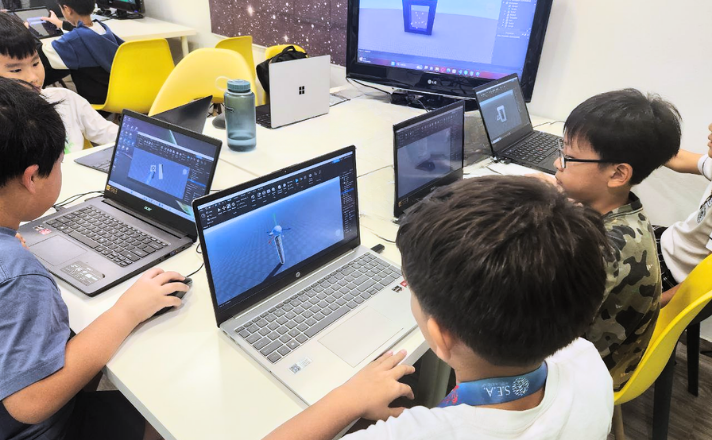
Empire Code rebrands as Empire AI and becomes the first school in Southeast Asia to completely rebuild its children’s curriculum around the way technology is actually built today – with AI, not despite it.
FOR IMMEDIATE RELEASE – SINGAPORE, 2 April 2026:
Ask most parents what they want their child to learn in technology class, and the answer is usually: coding. Python, JavaScript, you name it. Something practical. Something that will matter when they grow up.
Empire AI, formerly Empire Code, understands that instinct completely. And it is precisely why the school, established since 2016, is making a big change.
Traditional coding as it has been taught in children’s schools – typing out lines of code, learning syntax (the exact rules of how a programming language is written), is no longer the skill that will define a child’s future in technology.
The industry has already moved on, and Empire AI is moving with it.
Effective from 1 April 2026, the school is retiring syntax-heavy coding from its curriculum for all age groups, and replacing it with something more powerful: the ability to think with AI, create with AI, build with AI, and understand how the technology shaping our world actually works.
The rebrand from Empire Code to Empire AI is not a name change. It is a new direction.
“We are not just updating our curriculum. We are completely re-imagining it. Empire Code was built for a world where learning to code was the skill. Empire AI is built for the world that already exists.”
“We are not just updating our curriculum. We are completely re-imagining it. Empire Code was built for a world where learning to code was the skill. Empire AI is built for the world that already exists.”
Why Now? What Has Actually Changed in the Industry
Here’s something many coding schools may not have fully shared yet:
The world’s largest technology companies – such as Google and Oracle – have all publicly confirmed that artificial intelligence now writes a significant portion of the code their engineers work with.
The way software is built has fundamentally changed. Tools like Claude Code now allow professionals to build working applications by describing what they want in plain English, rather than writing thousands of lines of commands from memory. In AI-native development, developers work inside environments like Cursor; using AI agents to generate, debug, and iterate on code in real time.
The technical bottleneck is no longer syntax. It is systems thinking: understanding how to architect a solution, break down a problem, and communicate intent precisely. That is the skill set that matters now.
This has had a direct impact on hiring. The entry-level jobs that once went to people who had spent years learning to write code manually are shrinking.
Oracle made global headlines recently when it significantly reduced the size of its engineering workforce. This is not an isolated case – it reflects a broader shift happening across the technology industry.
In short: the job that parents imagine their child studying towards in technology related fields in the traditional sense – is being transformed faster than most school curricula have acknowledged.
Empire AI believes it is time to be honest about this, and to act on it.
– AI can now generate working software from a plain-English description, not syntax– The skill that matters today is knowing what to build, how to direct AI to build it, and how to judge whether it works
– Children entering the workforce in ten years will be evaluated on their ability to work with AI as a creative and technical partner – not on whether they can recall programming syntax
– Schools that continue teaching traditional coding are preparing children for a version of the technology industry that is rapidly disappearing
“We are preparing children for jobs that require understanding AI, not just using it as a shortcut.”
“We are preparing children for jobs that require understanding AI, not just using it as a shortcut.”
What Is Actually Changing in the Classroom
The Empire AI curriculum covers children aged four through nineteen. Here is what parents need to know about what stays, what changes, and what their child will be learning:
Robotics – Growing, Not Going
Robotics is staying and expanding. Building and programming physical robots teaches children something no screen-based activity can replicate: the understanding that actions have consequences, that design decisions matter, and that real-world problems require real-world thinking. Empire AI is bringing in new robotics tools that incorporate AI, so children can experience firsthand how intelligent machines work.
Block Programming – Still Here, Used Differently
Tools like Scratch, ScratchJr, Tynker, and Minecraft Education are remaining in the programme. Block programming – where children drag and snap visual pieces together to create sequences and logic, like digital building blocks – is a powerful way to teach young minds how to think step by step. What changes is the emphasis: less focus on the mechanics of code itself, more on the reasoning behind it, and how those ideas connect to science, maths, and the creative arts.
Game Development – Now Includes How to Build a Business
The creative and strategic thinking involved in building a game – designing rules, understanding how systems interact, making decisions about user experience – remains one of the best ways to teach complex thinking. Empire AI is updating this area to reduce the manual coding components and add something new: entrepreneurship. Students will learn not just how to create a game, but how to think about it as a product – how to design it for an audience, and how it could generate real-world value.
App Development – Building Real Things, the Modern Way
Younger students will learn how apps are actually made today, not by typing code from scratch, but by combining ideas, logic, and AI tools to bring something to life. For teenagers, this becomes more advanced: they will work on building real, functional applications by directing AI tools, connecting to live data sources (called APIs – think of them as bridges that let apps talk to each other and to the internet), and deploying their creations online so others can actually use them.
Electronics and Hardware – Real Technology, Real Hands
Physical electronics remain central to the curriculum. Platforms like Arduino (a small programmable circuit board), Micro:bit (a pocket-sized computer designed for learning), and Raspberry Pi (a credit-card-sized computer used for real projects worldwide) stay in place. Children will increasingly learn to combine these physical devices with AI – building things that sense, respond, and adapt to the world around them.
Traditional Coding Languages – Being Retired
This is the significant shift. Languages like Python and JavaScript where students spend hours learning precise syntax rules, memorising commands, and debugging line-by-line, are being phased out. In their place, students will learn to build using AI as a creative partner: describing what they want in natural language, understanding how AI interprets and executes those instructions, connecting their creations to real services and data, and getting them running in the real world.
Why This Matters to Parents
Singapore’s Smart Nation vision has placed technology and innovation at the heart of how this country is preparing for the future. Parents here are already living in that context. They see it in their workplaces, in the conversations around them, and in the questions their children are beginning to ask.
Those questions deserve honest answers. What will my child’s career look like? What skills will actually matter? How do I make sure the education they are receiving today is genuinely preparing them for what comes next?
Empire AI’s curriculum overhaul, covering every age from four to nineteen, is built around those questions. It is not a response to a trend. It is an acknowledgement that the technology landscape has shifted in ways that are already visible, and that children’s education should reflect that reality sooner rather than later.
About Empire AI
Empire AI (formerly Empire Code) is a Singapore-based technology education school for children aged four to nineteen. As one of Singapore’s longest-running STEM enrichment centres, established in 2016, the school offers programmes in robotics, AI-integrated learning, app development, game development, electronics, and hardware engineering.
Its mission is to move beyond technology as a technical subject and towards technology as a way of thinking, creating, and building so that every child who comes through its doors leaves with the confidence and capability to shape the world ahead of them.
Empire AI is headquartered in Singapore and serves students across the region.
Register for a Free Trial Coding or Robotics Class
Empire Code offers trial coding and robotics classes for children aged 4 to 16, taught by MOE-registered and carefully selected educators who support early and primary learners with clarity, structure and genuine care.
A single session is often enough to see what your child naturally gravitates to – coding, robotics, or a little of both. Please complete the form below and our team will be in touch with you shortly to arrange a trial class.
*By submitting the form, you agree to our Terms and Conditions
Google Reviews
Posted on Google
 YewHock TAN31 August 2026
 Interesting topics which are practicle and useful for beginners. Additional Course on 29th Aug 2026 The AI course on Bazi by Empire.AI was a wonderful eye opener! I also learn a lot about NotebookLM, and was able to generate ppt slides, video in both English and Chinese, and last but not the least, an interview audio file on the project. The co-organiser, Ningpo Guild, was very hospitable, too!Posted on Google
 LC Liu29 August 2026Very good course for beginners. Zheng Xuan is a very patient teacherPosted on Google
 Jonathen Chen29 August 2026Trainer Zheng Xuan able to share with interesting topics using AI to build & enhance our life time experiencesPosted on Google
 Phillip Tan29 August 2026Good contentPosted on Google
 Florence Ang29 August 2026Learnt something new today about AI! Great job!Posted on Google
 Peifang Tang24 August 2026I had learnt there as a trail and really enjoyed itPosted on Google
 Foo Loy Yong22 August 2026I learnt a lot therePosted on Google
 david chan1 August 2026Mr Low Z X did a very gd presentation. Enjoy the lively moment. Well done. Thank youPosted on Google
 Yuna Bong2 July 2026I would just like to share this gem of a place that's tucked away in Goldhill Plaza - it's affordable (VERY value for money), has great instructors, clean and cosy, and does an excellent job in developing robotics/coding/building skills in children. I was first introduced to this place by a good friend, and after the first class, my 5 year old was instantly sold! I love that young children get the chance to build their own structures (great for fine-motor skills), learn simple block coding, and test out their creations on the spot. I also appreciate the fact that they are very flexible - there are many learning pathways and we can choose which suits our child best. The centre gives great recommendations to suit each child's needs, and there are a variety of modules available - we are simply spoilt for choice! Replies and updates are also very prompt - there are photos/videos of my child every lesson, and all questions are promptly replied via WhatsApp. Those looking for a great place for their children to try out coding/robotics/building etc should definitely give this centre a try. :)Posted on Google
 KA Group Asia29 May 2026The staff here are incredibly kind and professional. My kids have been attending classes for Minecraft Education and Scratch, and they are always engaged and excited to return. The curriculum is fun, effective, and truly sparks their interest in coding. I highly recommend Empire AI to any parent looking for a great enrichment center!Posted on Google
 Mehraj Begum28 May 2026My children are going through the exposure modules. Their experience is amazing. The teachers are very patient and explained the steps clearly. They also provided a wide exposure to many different coding experiences and platforms which allows parents to discover our child’s strengths and niche. Teachers are motivating and cheerful. Their belief in gender equality in the domain of STEM is truly inspirational. Empire code also partners with Social Enterprises which teach children empathy and their contribution towards helping the needy. Thank you Empire Code!Posted on Google
 QYL Ho19 May 2026We would like to thank Empire Code for the engaging and interesting robotics lessons. My son has been thoroughly enjoying every class and always looks forward to attending. The teachers make learning fun, interactive, and encouraging, which has helped spark his interest in robotics and coding. We truly appreciate the patience, dedication, and positive learning environment provided. Thank you for making the classes such an enjoyable experience for him!Posted on Google
 Emma7 May 2026My kids attend Empire AI Novena and we’ve had an amazing experience so far! The teachers are caring, patient, and truly passionate about teaching. Special shoutout to Teacher Aaron for being so encouraging and supportive with the students The curriculum is well-designed, engaging, and helps children learn AI and tech concepts in a fun and meaningful way. My kids always look forward to class and have gained so much confidence and knowledge. Highly recommend Empire AI Novena to parents looking for a great learning environment for their children!!Posted on Google
 Ray Tio25 April 2026My Son is on his 3rd Module and almost 40hrs of online lessons. He is always looking forward to his weekly class and enjoys the lessons. We had never been to the school before and everything were coordinated through WhatsApp. Everything is just 1 text away. I just signed up for another 30hrs of lessons before writing this. Remember to check for promotions!Posted on Google
 User10 April 2026Very funPosted on Google
 spoiled Milk10 April 2026Incredible experience here. As the teacher not only are very kind, but they are friendly to our needs and I learnt a lot thanks to their patience and kindness. Especially teacher ZX who is good😀.Posted on Google
 Francis Chong26 February 2026Lovely education centre that I send my son to for coding. He absolutely loves it. The teachers are passionate, education is solid, awesome and fun; not to mention that they have wonderful founders and supporting staff as well. Prices are reasonable too! Can't ask for more la. The above is not AI generated ;)Posted on Google
 Ed24 February 2026A lovely place to learn Robotics! My boy has enjoyed his sessions and facilitators are patient and knowledgeable 😍🙏🏼 thx!Posted on Google
 xiaoyan wang30 January 2026My son enjoys this course very much . We have been traveling here during the vacation and join the classes .Posted on Google
 A28 January 2026My child loves his lessons at Empire Code. The instructors are knowledgeable, helpful, kind and very encouraging. He has learnt a lot in his robotics classes. wPosted on Google
 Nelson Loh26 January 2026I asked my P3 boy which enrichment he may want to drop since he has too 5 on hands… he replied, definitely not Empire coding! It is fun & educational, he loves it very much :)Posted on Google
 はるあお19 January 2026We had a wonderful experience at this Minecraft coding class in Singapore. When we shared our concerns about our children not understanding English, the school kindly adjusted the schedule and arranged more individualized support for them. Although my two children did not understand much English at first, the teachers patiently and warmly supported them throughout the lesson. They stayed close to the children, helped them stay focused, and guided them using the children’s interests, which made learning in English enjoyable and positive. We are traveling from Japan, and being able to include this programming class during our trip was truly valuable. We were very impressed by the high level of coding and STEAM education in Singapore. The administrator was also very kind and friendly, and it is clear that this school has experienced and excellent teachers. We are truly grateful for this experience and highly recommend this school.Posted on Google
 dw dw18 January 2026My child really enjoyed the coding classes at Empire Code, especially the LEGO Robotics and Scratch Junior programmes. The lessons are engaging and well-structured, making learning fun and hands-on. The Novena location is very convenient, and the open house was useful for letting us try out the classes before enrolling. Overall, a great learning experience for young learners.Posted on Google
 Kheng Zx17 January 2026My kids is quite happy and enjoy the classPosted on Google
 paul yun17 January 2026Our kids tried the first lesson at Empire code and likes very much. We believe it will be good for him to learn the coding robotics at early age. We recommend the Empire code.Posted on Google
 Janice Tan16 January 2026My child has been attending this robotics class for almost two years, starting from when he was 4 years old, and he has never missed a class. He looks forward to it every week and is always very excited after class to show me what he has built. He is especially proud of toggling between different commands to make the robot perform different actions. We’re really glad we found this place, and he has truly enjoyed learning here. I would definitely recommend it to friends who are looking for a robotics class for their kids.Posted on Google
 Silver wolf31 December 2025Minecraft is so funPosted on Google
 HH Bay11 December 2025Empire Code Novena offers a Roblox course that teaches kids real coding concepts instead of just playing games. Through guided lessons, students learn to design their own worlds, scripts, and game mechanics. This helps them understand logic, creativity, and problem-solving in a fun, hands-on way. Parents appreciate that screen time becomes productive as children build and create rather than only consume. Overall, the course turns gaming interest into valuable digital skills for the future.Posted on Google
 Jeanne Chin2 December 2025Empire code was a perfect place for my child's learning of robotics and coding. The teachers were wonderful and my child always come home excited about what he learnt. I like that the classes go by credits and lessons are flexible for me to switch around when our schedule changes. Felicia has been super helpful and patient in guiding us through the DSA roadmaps when applying for sec schs.Posted on Google
 Martin15 November 2025Good learning environment with friendly stuff and trainer. Recommend to parents with children interested in coding class.Posted on Google
 silly dinny15 November 2025We just want to thank the trainer today for being so kind and patient with our boy. He wanted to show me his robot at the end of class but somehow it didn't work after a few tries due to our tablet's issue. Although it took extra time to help him reconnect with another ipad (he was the last kid to leave), she was extremely helpful and patient. Your reception staff was also very gentle and friendly to our kids. In fact, week after week, the trainers and reception staff have shown so much care and patience towards him and his brother. We truly appreciate it and our kids love coming here every week for class! 🙏Posted on Google
 Marc Wong6 November 2025I really appreciate how patient the teachers are and how the education team regularly updates the curriculum. It keeps the learning experience fresh, engaging and relevant for the kids.Posted on Google
 Pauline Huang30 September 2025My son had a wonderful time celebrating his birthday at Empire Code with his classmate. Thanks to Empire Code to set up all the decoration and conduct the fun coding class according to my son's favourite character which is Pokemon. He and his friends were enjoying creating their own pikachu and learnt how to do coding with it. After that we had our party meal and also cutting birthday cake. Thanks to Empire Code to make my son's birthday unforgettable!Posted on Google
 Linda Lim20 September 2025My child recently attended the MineCraft Code and Cake Workshop and it was an excellent experience from start to finish. The program was well-organized, engaging, and provided the right balance between learning and fun. More importantly, my son came back talking happily about what a great experience he had. The added bonus is that it is a 1 day workshop including lunch on a Saturday, which save a lot of logistic issues and a meaningful way to spend a weekend.Posted on Google
 Adelia Seng18 August 2025My son has been attending robotics classes at Empire Code Novena, and has been having a fantastic time there. He's not only learning valuable skills in robotics, but have also been introduced to foundational coding concepts and having a ton of fun. The instructor is great at keeping the kids engaged and making complex topics easy to understand. We've seen a noticeable boost in his confidence and problem-solving abilities since he started. We highly recommend this class to any parent looking for a fun and educational activity for their child!Posted on Google
 Ly15 August 2025My child has been at Empire Code for many good long years now, it has become one happy place of fun learning, exploring and confidence. The Coaches are Champions! Empire Code support competence and the partnership maintained with parents is noteworthy.Posted on Google
 Ria Chee13 August 2025My son just finished the LEGO Spike 1 Robotics class and absolutely loved it! The lessons were fun, hands-on, and taught him so much about building, coding, and problem-solving. The instructors were fantastic, the admin team was very helpful, and every staff member was friendly. He’s now moving on to LEGO Spike 2 and is so excited to join the competition next year when he’s ready. My mommy friends have even started joining and inquiring after seeing how much he enjoyed it. I highly recommend EMPIRE CODE Novena.Posted on Google
 Stepyi11 Y2 August 2025My kid loves this coding class, he is looking forward to each session.Posted on Google
 ados31 July 2025The instructors are patient, knowledgeable, and make learning fun. It’s a very professional program,we’ll definitely keep coming back!Posted on Google
 Cec22 July 2025Flexible in class arrangements and willingness to based on child’s ability. In-charge is hands on, and working in constant improvement. If looking for coding and robotic school, can check them out!Posted on Google
 Jane Tan22 July 2025My son has been with Empire Code for a few years. He enjoyed each class and have learnt many new applications such as scratch, minecraft, roblox. The instructors are patient and the customer service is very prompt in updating and responding to us.Posted on Google
 Ying Chen21 July 2025Empire Code is a fantastic training centre that inspires children’s interest in coding. We first discovered it when my son saw their advertisement. He was interested, so I enrolled him in a holiday programme. Since then, he has continued with Scratch, Python, and other courses there. He is very enthusiastic and looks forward to going every weekend. The teachers are caring, experienced, and very considerate. We are truly grateful for their dedication.Posted on Google
 Hosiana Hosiana20 July 2025Our 7-year-old son has really enjoyed his time at Empire Code Novena. He took LEGO Robotics and ScratchJr coding classes, and it's been a great way to introduce him to the world of tech. Every lesson is hands-on and fun - he comes home excited to show us what he's built or coded. The trainers are great with kids and really know how to keep them engaged. The Novena center is clean, safe and well set up for young leaners. It's not easy to find coding and robotics classes for young kids in Singapore that strike the right balance between fun and learning - but Empire Code does just that. Would definitely recommend it to any parent looking to give their child a strong start in tech!Posted on Google
 hanna lee18 July 2025I was initially unsure about online coding classes, but Empire Code completely changed my mind. My son had a blast with their Minecraft coding course on Zoom, and I loved seeing how engaged he was from the very first session. What stood out to me most was how the lessons sparked his creativity while teaching him real coding logic through a platform he already loves - Minecraft! He wasn’t just playing; he was learning and building with purpose. The trainer was so warm and encouraging - even over Zoom, she managed to connect with the kids and guide them patiently. As a parent, I appreciated how organised the sessions were and how much my son looked forward to them each week. If you're looking for online coding classes for kids in Singapore that are meaningful, fun, and educational, Empire Code is a wonderful choice.Posted on Google
 Zixiang Fu18 July 2025This is a coding and robotics centre for young children and they are fantastic. My son is attending coding classes here and the teachers are knowledgeable, attentive and caring. My son came home happy after every session and has been constantly sharing with me what he has learnt at Empire Code. Glad we found a centre that takes care of his learning while making it fun to learn.Posted on Google
 Joan Hamilton16 July 2025This is a thrilling place for kids! Empire Code’s material is leveled but challenging. It has even prepared my kids well for math competitions at their school (as they often include questions on coding), but my kids only see it as fun! The instructors are great and management is very organized and professional. Their camps are always a highlight of my boys’ summer. We have also held a party at Empire Code to rave reviews from our birthday boy and all of his friends! Highly recommend!Posted on Google
 kinghee teo12 July 2025My children enjoyed the classes at Empire Code immensely and have taken up an interest in coding. The instructors are friendly and patient with young children.Posted on Google
 Tim Q12 July 2025Great place for kids to learn coding and robotics! My kids love it and don’t want to go home!Posted on Google
 Yi xin Teo12 July 2025Empire code classes have been wonderful for my boys. They enjoy making Legos and learning about Minecraft coding. Recommend this place.Posted on Google
 Zia, Ying-Xian Chen12 July 2025課程很豐富,老師很認真、有耐心!
