CERTIFICATIONS
Badges and CertificationsPARENTS ACCOUNT
Parents PortalCALENDAR
Annual Closure DatesWhat Is My Child Actually Learning in Coding Class? A Parent’s Guide to Coding Terms and Real Skills
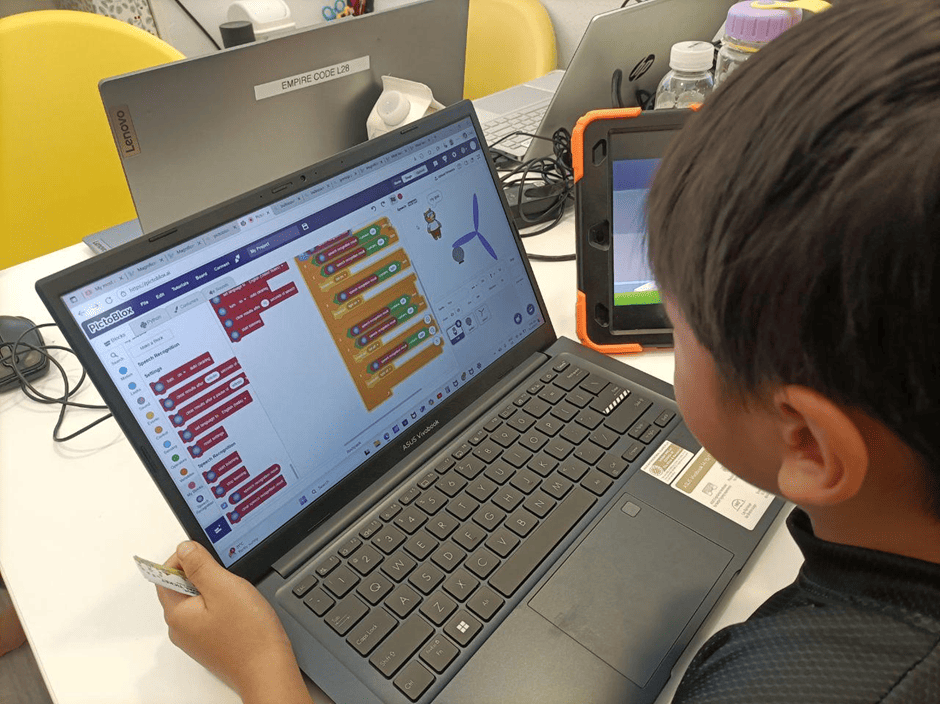
If you’re a parent reading this, you’ve probably had at least one of these thoughts:
“My child is spending more time on screens… is this really helpful?”
“Everyone talks about coding, but is it actually useful?”
“Is this just another enrichment trend?”
“Will my child fall behind if they don’t learn this?”
These are very normal questions.
Most parents are not trying to raise a future programmer.
You’re trying to raise a confident child who can think clearly, cope with challenges, and do well in school — while still having a balanced childhood.
So when you sign your child up for coding class, what you really want to know is:
Is my child learning something meaningful?
Good coding programmes today are not about typing complicated commands. They are about teaching children how to think, solve problems, and understand the technology they already use every day — from games and apps to school platforms and smart devices.
This guide explains what children actually learn in coding class, how it supports school learning, and how you can tell if a programme is truly helping your child.
Why Coding Matters for Students Today
Let’s be honest.
Our children are growing up in a very different world from ours.
They submit homework online.
They attend digital lessons.
They use learning apps.
They interact through screens.
Yet most of them don’t really understand how these systems work.
They just “use” them.
Learning coding helps children move from being passive users to active thinkers.
Many parents are looking for programmes that can:
● Help their child think more clearly
● Build confidence through making things
● Support Math and Science learning
● Improve digital literacy
● Prepare them for future studies
Good coding education does exactly this.
It trains children to slow down, think step by step, and understand cause and effect — skills that are useful far beyond computers.
What Children Learn in Coding Class
Strong coding programmes focus on five main areas that directly affect how children learn and grow.
1. Learning How to Think Through Problems
One of the biggest benefits of coding is computational thinking.
In simple terms, it teaches children how to approach problems calmly and logically.
They learn to:
● Break big problems into smaller parts
● Look for patterns
● Plan before acting
● Test and improve their ideas
Many parents notice that over time, their children become more organised in their thinking and less easily frustrated when facing difficult tasks.
These skills support Math, Science, and even writing and project work.
2. Understanding How Programming Works
Children don’t jump straight into complicated code.
They usually start with simple, visual tools and grow from there.
Most programmes follow this path:
● Block-based coding (such as Scratch)
Children use colourful blocks to build programs. This helps them focus on thinking, not typing.
● Text-based coding (such as Python or JavaScript)
Later, they learn to write real code, similar to what professionals use.
This gradual approach prevents children from feeling overwhelmed and builds confidence step by step.
Coding Terms Explained Simply
Understanding common coding terms helps parents follow what their child is learning.
● Algorithm: A step-by-step method to solve a problem
● Debugging: Finding and Fixing errors in code
● Loop: Repeating a set of instructions
● Variable: A value that can change
● Function: A reusable set of instructions
● Conditional: Code that makes decisions (if/else logic)
● Input/Output: How programs receive and display information
3. Creating Their Own Games and Projects
Good coding classes don’t just teach theory.
SChildren actually build things.
They may create:
● Games
● Animations
● Simple apps
● Digital stories
● Simulations
This is where learning becomes real.
When children see their own ideas working on screen, they feel proud. They feel capable. They feel motivated.
For many children, this is the first time they experience “I made this myself.”
That confidence carries into school and other activities.
4. Learning Through Robotics and Hands-On Tools
Many programmes also include physical devices such as:
● Micro:bit controllers
● Robotics kits
● Sensors and motors
Children write code and see real objects respond.
For example, a robot moves. A light turns on. A sensor reacts.
This helps children understand that coding is not just “on a computer” — it controls real-world systems too.
Hands-on learning is especially helpful for children who learn better by doing.
5. Learning Not to Give Up When Things Go Wrong
Every coding student experiences this:
The programme doesn’t work.
The game crashes.
The robot doesn’t move.
And that’s the point.
Coding teaches children how to:
● Stay calm
● Find mistakes
● Fix problems
● Try again
Instead of giving up, they learn persistence.
Many parents find this is one of the most valuable life skills their child gains from coding.
How Coding Helps in School and Beyond
When taught well, coding supports learning in many areas.
It helps children:
● Improve logical thinking
● Focus better on tasks
● Plan their work
● Communicate ideas clearly
● Work in teams
● Present projects confidently
These skills benefit subjects like:
● Mathematics
● Science
● Design & Technology
● Project-based learning
Over time, children also build personal portfolios of their work, which can be useful for future programmes and opportunities.
More importantly, they learn how to learn — a skill that lasts for life.
What Should Parents Look for in a Coding Programme?
Not all coding classes are the same.
Before choosing, parents may want to ask:
“Does the programme have a clear learning path?”
“Do children build real projects?”
“Are teachers patient and supportive?”
“Is there exposure to both software and hardware?”
“Do children get chances to share their work?”
Programmes that balance structure with creativity tend to keep children engaged and confident in the long run.
Common Worries Parents Have
“My child is not very good at Math. Can they still learn coding?”
Yes. Many children improve their logical thinking through coding, even if they struggled before.
“Will this add too much pressure?”
Good programmes keep learning enjoyable and paced appropriately. Coding should not feel stressful./p>
“Should this replace sports or arts?”
No. Coding works best as part of a balanced childhood, alongside physical activity and creative play.
The Bottom Line for Parents
Coding classes are not about turning every child into a tech expert.
They are about helping children become:
● Better thinkers
● More confident learners
● Responsible users of technology
● Calm problem-solvers
● Adaptable individuals
In today’s fast-changing world, these qualities matter more than any single subject.
For many families, coding is not an investment in a career.
It is an investment in how their child learns, thinks, and grows.
Register for a Free Trial Coding or Robotics Lesson
Empire Code offers trial coding and robotics classes for children aged 4 to 16, taught by MOE-registered and carefully selected educators who support early and primary learners with clarity, structure and genuine care. Please complete the form below and our team will be in touch with you shortly.
*By submitting the form, you agree to our Terms and Conditions